
Collaborative Conversations for Autistic Teens: A Calm, Practical Guide (With Scripts)

If conversations in your home can go from a simple question to a shutdown, argument, or silence in minutes, you’re not alone. Many families are trying hard to communicate—yet the conversation keeps sliding into frustration.
This guide is a Mindful Marks approach to communication:
calm, concrete, and dignity-protecting
nervous-system aware (timing matters)
supportive of autistic communication differences (not “training” a teen to mask)
Quick win
If you want a simple reset for the next misunderstanding, download the Double Empathy Bridge (1‑Page Guide) here:
It includes a 3-step bridge to reduce blame and build clarity, plus scripts for caregivers and teens.
What a collaborative conversation really is
A collaborative conversation is a conversation where both people are working toward the same goal, even if they have different needs.
Most collaborative conversations include:
A shared purpose — What are we trying to solve or understand?
Shared respect — Both people’s needs matter.
Shared clarity — We say what we mean and we check what was heard.
A shared next step — We leave with an agreed plan, even a small one.
Collaboration is different from:
A lecture (one person talks, the other is expected to comply)
An argument (the goal becomes winning instead of understanding)
Masking (the teen forces themself through discomfort to “perform” communication)
Why this can feel harder for autistic teens (the “why”)
When conversations go sideways, it’s easy to assume it’s attitude or refusal. But for many autistic teens, a conversation can demand a lot at once.
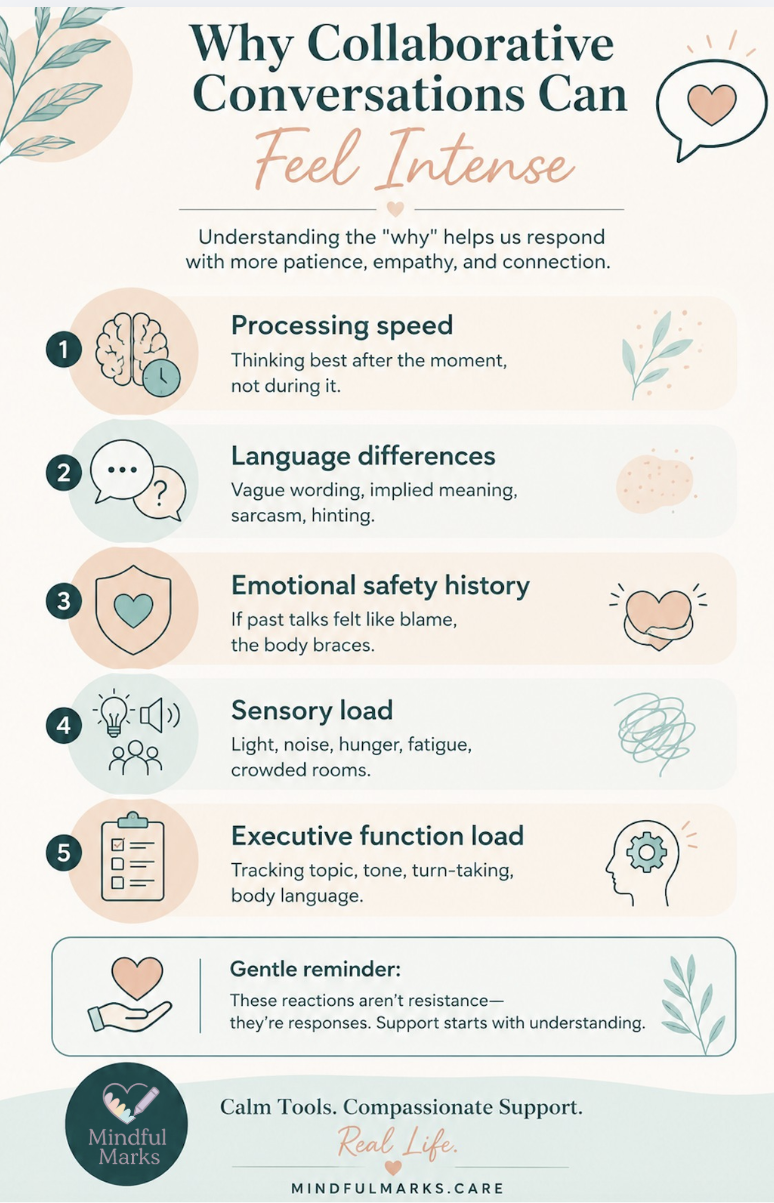
Common reasons collaborative conversations can feel intense:
Processing speed — thinking best after the moment, not during it
Language differences — vague wording, implied meaning, sarcasm, hinting
Emotional safety history — if past talks felt like blame, the body braces
Sensory load — light, noise, hunger, fatigue, crowded rooms
Executive function load — tracking topic, tone, turn-taking, body language
A helpful reframe
When a teen can’t collaborate in the moment, it’s often capacity, not character.
Why this matters (for teens and caregivers)
Collaborative conversations support:
Self-advocacy (“I need this.”)
Boundaries (“This isn’t okay for me.”)
Repair (“We got tangled—can we restart?”)
Safer relationships (parents, friends, teachers, coaches, coworkers)
The goal is not perfect communication.
The goal is safety, connection, and practical problem-solving.
The collaboration framework (the “how”)
When a conversation feels hard, structure can reduce pressure. Try this 5-part flow.
Step 1: Goal
Ask: What’s the one thing we’re trying to do right now?
Examples:
Make a plan for homework
Understand what happened at school
Decide one next step about a problem
Step 2: Format
Ask: What format makes this easier?
Talk
Text
Notes on paper
Break first, then talk
Step 3: Needs
Ask: What do you need to feel safe enough to talk?
Less eye contact
Lower voice
One question at a time
A fidget
A quieter space
A time limit
Step 4: Meaning
Ask: Can we check what we each heard?
Step 5: Next step
End with: What are we doing next, and when?
Before you start talking:
Set it up for success
Many communication problems are really timing problems.
Try these supports before you start:
Pick a lower-demand time (avoid right after school, right before bed, or during a sensory crash).
Ask permission: “Is now a good time to talk for 5 minutes?”
Keep it small: one topic, one goal.
Offer choices: “Now, after dinner, or by text?”
Use a time container: “10 minutes, then we pause.”
Make a pause plan (agree what happens if someone needs a break).
A simple pause plan you can co-create
Phrase: “Pause please” / “I need a minute”
Where: bedroom, porch, bathroom, quiet corner
How long: 5–20 minutes
How we return: text a thumbs up / “Ready for one more minute?”
During the conversation

Tools that keep it collaborative
Tool 1: Start with the shared goal
“I’m not here to argue. I want us to make a plan together.”
“We’re on the same team. Let’s figure out what happened.”
Tool 2: Use concrete language
Instead of “Clean your room,” try:
“Put dirty clothes in the hamper and throw away the trash on your desk.”
Instead of “Fix your attitude,” try:
“Your voice sounds tight. Are you overwhelmed—or upset with what I said?”
Tool 3: One question at a time
“One question, then we pause.”
Tool 4: Give processing time without punishment
“You can say ‘I need time,’ and we’ll come back to it.”
“It’s okay to answer tomorrow. Let’s pick a time.”
Tool 5: Confirm meaning (repeat-back)
“What did you hear me ask?”
“Let me try again—I think I said it in a confusing way.”
“What do you want me to understand?”
Tool 6: Use a visual anchor
write the goal on paper
make a short list of choices
use a notes app
keep a “parking lot list” for side topics
Scripts you can copy + paste
Caregiver scripts that lower pressure
“I want to understand. Can you help me see it from your perspective?”
“I might be missing something. What part felt hard?”
“Do you want comfort, problem-solving, or quiet support?”
“Would it help if we talked, texted, or took a short break?”
“I’m going to lower my voice. Let’s slow this down.”
“Let’s pick one next step, not ten.”
Teen self-advocacy scripts (respectful + clear)
“I need a minute to process. Can we talk later?”
“I want to explain, but I need one question at a time.”
“I’m not ignoring you. I’m overloaded.”
“Can we do this by text?”
“I need a break. I’ll come back in 10 minutes.”
“I think we misunderstood each other. Can we restart?”
Repair scripts (after a misunderstanding)
“I don’t think we meant the same thing. Can we reset?”
“Can we try that again with fewer words?”
“I’m sorry that landed harsh. That wasn’t my goal.”
“We can come back to this when we’re both calmer.”
Conversation starters that feel less intense
“What was the hardest part of today?”
“What would have helped in that moment?”
“Do you want advice, help, or just someone to listen?”
“What’s one thing you want me to remember about you?”
Common misunderstandings (and what helps instead)
“If my teen is quiet, they’re being disrespectful.”
What may be happening instead: processing, shutdown, fear of getting in trouble.
Try:
“Do you want time, fewer words, or a different format?”
“We can pause. You’re not in trouble.”
“If I explain more, it will help.”
What may be happening instead: more words can feel like more pressure.
Try:
one sentence goal
one choice question
“Collaboration means the parent gives in.”
What’s true instead: collaboration can include firm boundaries—without shame and power struggles.
Try:
“I can’t say yes to that, but I can say yes to these two options.”
What not to do (gentle reminders)
Don’t force eye contact.
Don’t demand an instant answer.
Don’t start the conversation during meltdown or shutdown.
Don’t use sarcasm or hinting as your main communication tool.
Don’t turn collaboration into compliance.
One thing to try tonight (5 minutes)
Pick one low-stakes topic and use this 3-part setup:
“Can we talk for 5 minutes?”
“The goal is one small plan—not solving everything.”
“Do you want to talk, text, or take a short break first?”
Helpful resources
ASAN (Autistic Self Advocacy Network) — autistic-led advocacy and education
Autism Society — family support, education, community resources
Understood.org — executive function + school support tools
Child Mind Institute — parent-friendly mental health information
Supportive conclusion
Collaborative conversations aren’t about having perfect words.
They’re about building safety, clarity, and mutual respect over time.
Some days will be smoother than others. That doesn’t mean you’re doing it wrong.
If you want a simple tool you can print and use the next time communication gets tangled, download the Double Empathy Bridge Below: