
Could This Be Me? Understanding Late Autism Discovery in Adults
“Have you ever felt like you didn’t quite ‘fit’ at social events, constantly observed yourself copying others, or wondered why you get drained by small talk? You’re not alone. Many adults discover later in life that they might be on the autism spectrum. This doesn’t mean something’s wrong—it just means your brain is wired differently. Let’s explore together.”

Introduction: When the Puzzle Starts to Make Sense
For many adults, discovering autism later in life feels like finally finding the missing piece of a lifelong puzzle. Maybe you’ve always felt “different,” worked hard to “fit in,” or wondered why social interactions felt more like a performance than something natural. If that sounds familiar, you’re not imagining it—and you’re not alone.
Autism doesn’t suddenly appear in adulthood. It simply may have gone unrecognized, especially in generations that grew up before today’s broader understanding of autism existed—particularly for women, people of color, and those who learned to mask their differences.
Realizing that you might be autistic isn’t about labeling yourself—it’s about understanding yourself.
Common Signs of Autism That Often Go Unnoticed in Adults
While every autistic person is unique, there are shared patterns that often lead adults to ask, “Could this be me?”
Here are some signs that may resonate:
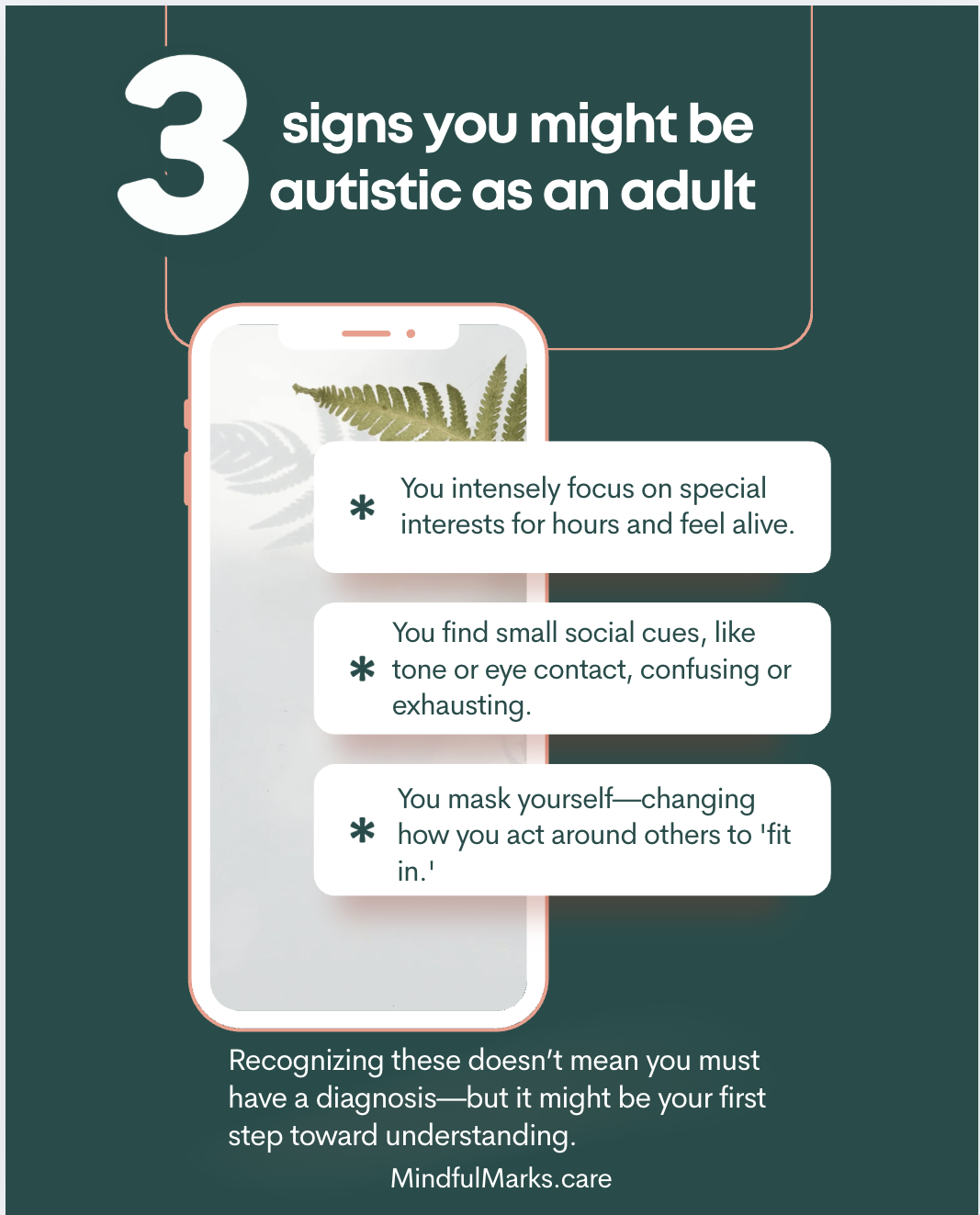
Social fatigue and “masking” — You often mirror others’ tone, body language, or expressions to blend in, but feel emotionally drained afterward.
Deep focus and intense interests — You can spend hours researching a topic you love, even losing track of time.
Sensory sensitivities — Noises, bright lights, clothing textures, or certain smells can feel overwhelming or painful.
A need for predictability — Sudden changes or unclear expectations make you anxious or unsettled.
Literal thinking — You prefer direct communication and can find sarcasm or vague instructions confusing.
Difficulty identifying emotions (your own or others’) — You may know you’re upset but struggle to describe exactly how or why.
Struggles with small talk, but loves deep conversations — Casual chatter feels pointless, but meaningful discussions energize you.
Feeling “too much” or “too little” — You’ve been told you overreact, don’t react enough, or seem detached.
If several of these feel familiar, it doesn’t mean you are autistic—but it may be worth exploring further.
Save this for later!
Why So Many Adults Are Only Just Finding Out
Autism awareness has changed dramatically in the past two decades. Older diagnostic models focused mostly on how autism presents in young boys. As a result, many adults—especially women and people of color—were overlooked or misdiagnosed with anxiety, depression, ADHD, or personality disorders.
Today, we understand that autism looks different in everyone.
Some people are naturally quieter and introspective. Others are outgoing but still struggle with sensory overload or social dynamics. These differences don’t make you broken—they make you human.
What to Do If You Think You Might Be Autistic
If you’re beginning to connect the dots, here are gentle steps to help you move forward:
Learn from autistic voices – Read blogs, podcasts, and videos from autistic adults sharing their experiences. Firsthand perspectives can be eye-opening.
Take reputable self-assessments – Tools like the RAADS-R, AQ Test (Autism-Spectrum Quotient), or CAT-Q (Camouflaging Autistic Traits Questionnaire) can help identify traits to discuss with a professional.
Seek a qualified evaluation – Look for psychologists or neurodiversity-affirming clinicians experienced with adult assessments.
Reflect on your life story – Journaling about childhood experiences, sensory triggers, and relationships can help you see long-term patterns.
Join supportive communities – Online and local groups can help you feel less alone and provide validation from people who truly “get it.”
Reframing What “Being Autistic” Means
Discovering that you may be autistic isn’t about limitation—it’s about liberation.
It’s the freedom to stop pretending and start honoring your real self.
Autistic adults often share that post-discovery, life feels calmer, more authentic, and more joyful. You may start adjusting your environment—like reducing sensory stressors, setting clearer boundaries, or creating routines that work for you rather than against you.
There’s power in understanding your brain’s unique rhythm.
Final Thoughts: You Are Not Alone
If you’ve ever wondered, “Could this be me?”, know that asking the question is already a brave step. Whether you choose to pursue a diagnosis or simply learn more about neurodiversity, this journey is about compassion—for yourself, your past, and your present.
You’re not broken.
You’re not overthinking.
You’re learning to see yourself clearly, perhaps for the very first time.
MindfulMarks Takeaway
At MindfulMarks.care, we believe that self-discovery is an act of healing.
If you’re on this path, take it one mindful mark at a time—through reflection, creativity, and community.
Explore our free resources, gentle guides, and sensory-friendly coloring tools designed to help autistic teens and adults reconnect with calm, confidence, and self-understanding.
Does any of this feel familiar?
➡️ Read next:
“Three Signs You Might Be Autistic as an Adult (and What They Really Mean)”
Infographic of : Three Signs You Might Be Autistic as an Adult (and What They Really Mean)