
Masking & Autistic Burnout: Signs, Load-Reduction, and Recovery Support
If your teen holds it together all day… and then falls apart at home, you’re not imagining it.
A lot of families describe the same pattern:
school looks “fine”
home looks like meltdowns, shutdowns, irritability, tears, or total collapse
tasks that used to be doable suddenly feel impossible
you’re walking on eggshells and you don’t know which version of the day you’re going to get
It’s easy to assume it’s attitude.
But for many autistic teens, it’s something else:
masking + load + not enough recovery = burnout.
This post will walk you through:
what masking can look like (in real life)
what autistic burnout is (and what it is not)
signs your teen may be in a burnout season
how to reduce daily load without removing dignity or expectations
a calm “Lower the Load” recovery plan you can start this week
scripts for home and school
Everything here is meant to be neuroaffirming, shame-free, and practical.
What Is Masking (In Plain Language)?
Masking (sometimes called camouflaging) is when an autistic person uses extra effort to appear “more typical” in order to:
avoid being judged
avoid bullying
reduce unwanted attention
meet expectations they didn’t choose
stay safe socially
Masking can look like “good behavior” from the outside.
But it often costs a lot on the inside.
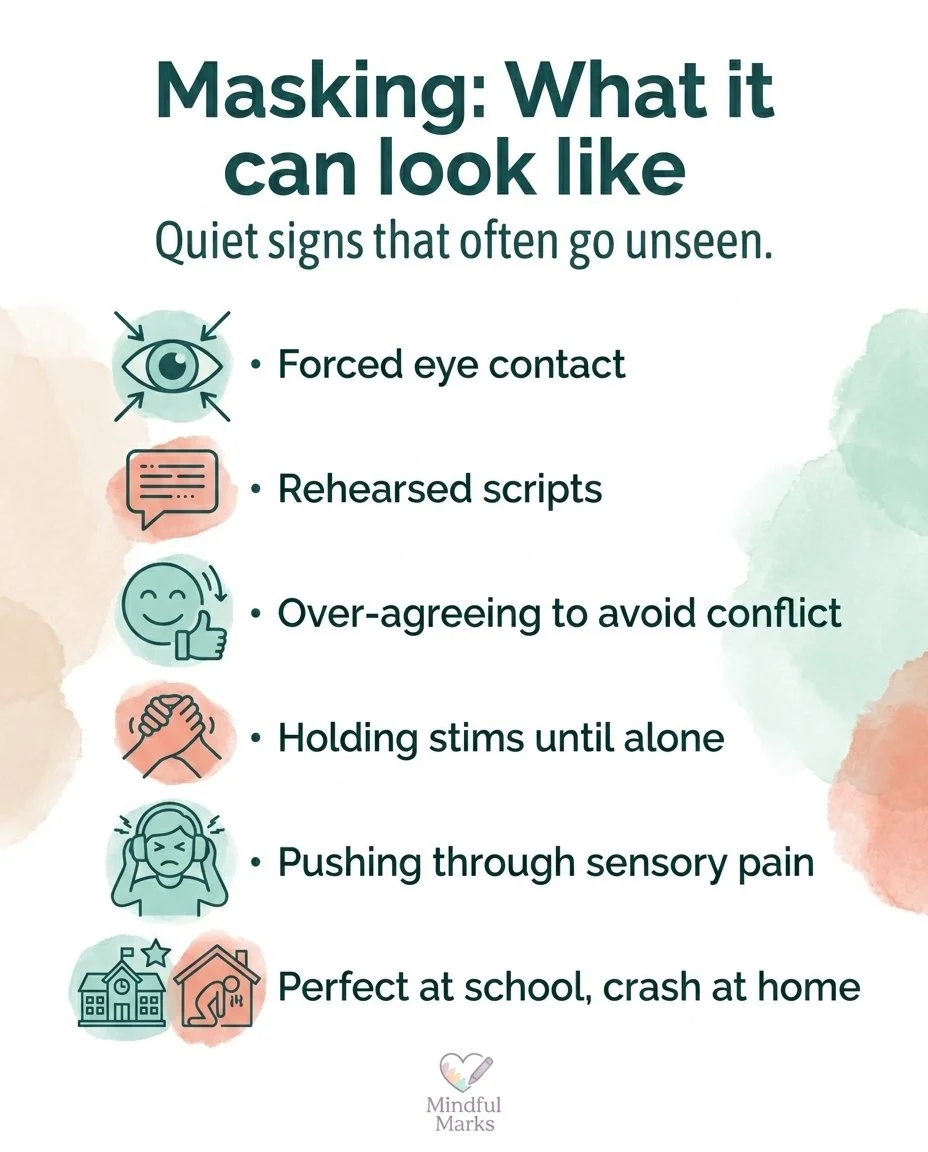
Common masking examples in teens
forcing eye contact
rehearsing conversations in advance
copying other teens’ tone, slang, or facial expressions
suppressing stimming until they’re alone
over-agreeing to avoid conflict
staying silent to avoid “saying the wrong thing”
pushing through sensory pain (noise, lights, clothing, crowds)
being “perfect” at school, then crashing at home
Important: masking is not a character flaw.
It’s often a survival strategy in environments that don’t fit.
What Is Autistic Burnout?
Autistic burnout is a state of intense physical, emotional, and cognitive exhaustion that can happen after prolonged periods of:
high demands
sensory/social strain
ongoing stress
and not enough recovery or support
Burnout is not “laziness.”
Burnout is not “defiance.”
Burnout is not “not trying.”
Burnout is often reduced capacity.
That means your teen may not be able to access skills that were previously available—especially under pressure.
Why This Matters
When we misread burnout, we usually respond by turning up the heat:
more pushing
more consequences
more lectures
more “you can do it, just try”
But burnout isn’t solved by trying harder.
Burnout is solved by reducing load and rebuilding capacity.
Correctly naming what’s happening helps you choose supports that actually work—and prevents unnecessary shame for your teen and for you.
Signs Your Teen May Be Masking (Even If They “Seem Fine”)
Masking is often invisible until it isn’t.
Here are signs your teen may be spending a lot of energy masking:
“perfect” or high-performing at school, depleted at home
social exhaustion after even short interactions
increased anxiety before school or events
scripted, overly polite, or “performance” communication
rigid routines around appearance/behavior
a strong fear of being misunderstood
irritability or shutdown after social situations
identity confusion (“I don’t know who I am” / “I don’t know what’s real”)
Signs of Autistic Burnout (In Teens)
Burnout can look different from teen to teen. Common signs include:
more meltdowns or shutdowns
more irritability or “snapping”
increased sensory sensitivity (noise, touch, light, clothing)
more school refusal or “can’t go” mornings
sleep disruption (too much sleep, not enough sleep, or unrefreshing sleep)
loss of interest in previously loved activities
brain fog, slower processing, more “I don’t know”
reduced executive function (starting, planning, finishing)
increased anxiety or despair
more physical complaints (headaches, stomachaches)
If your teen has new or severe mental health symptoms, it’s appropriate to seek professional support. This post is education—not diagnosis.
The Invisible Load That Makes Burnout More Likely
Autistic teens often carry load that others don’t see:
sensory strain (school is loud and bright)
social decoding (figuring out tone, sarcasm, shifting friendships)
constant transitions
executive function demands (multi-step assignments, deadlines, juggling classes)
masking effort
anxiety and uncertainty
being corrected or misunderstood repeatedly
By the time they’re home, there may be no capacity left for “simple” tasks.
The Goal: Reduce Load Without Reducing Dignity
A lot of caregivers worry:
“If I reduce demands, am I lowering expectations forever?”
Not necessarily.
Think of burnout support like a sprained ankle:
You don’t run on it to “build stamina.”
You protect it, reduce strain, and rebuild capacity gradually.
Burnout support is the same:
reduce strain
increase recovery
adjust expectations temporarily
rebuild skills slowly with choice and support
This is how you protect long-term independence.
The 5 Support Pillars (Mindful Marks framework)
1) Reduce demands (temporarily, strategically)
Choose the top drains and pause what you can for a short season.
2) Increase recovery time (daily and weekly)
Recovery isn’t only sleep. It’s nervous system safety.
3) Build sensory safety at home
Home should be the place the nervous system can exhale.
4) Validate reality (no minimizing)
Validation reduces threat and helps a teen stay connected.
5) Collaborate on accommodations (home + school)
Support needs are not rewards. They’re access tools.
A Simple Burnout Recovery Plan: “Lower the Load”
Use this as a calm starting point. Keep it small.
Step 1: Identify the top 3 drains
Ask:
“What part of the day costs you the most?”
“What makes your body feel tense?”
“What makes you want to disappear?”
Common drains: mornings, transitions, crowded hallways, lunch, certain classes, group work, social pressure, homework volume.
Step 2: Pick 3 things to pause (for one week)
Examples:
reduce after-school chores
pause non-essential social events
simplify dinner expectations
reduce homework battles (prioritize essential assignments only)
shorten showers or make hygiene “minimum viable”
Step 3: Add 2 supports that help the nervous system
Examples:
decompression time right after school (no questions)
snack + water ready
headphones
dim lights
movement break
quiet corner setup
predictable routine
Step 4: Add 1 daily recovery ritual (10 minutes)
Keep it realistic:
weighted blanket + quiet time
warm shower + low light
drawing/coloring
calming music
sensory tool
short walk
Step 5: Review what changed (data, not judgment)
Ask:
“Did anything feel easier?”
“Did any symptoms reduce?”
“What made it worse?”
Scripts & Examples (Copy/Paste)
Scripts for caregivers
“I believe you. We can make life lighter for a while.”
“You’re not in trouble. This looks like burnout/low capacity.”
“We don’t have to push through everything today.”
“Let’s pick one thing to drop this week.”
“I get it… and we still need a plan. Let’s make it smaller.”
Scripts for teens (self-advocacy)
“I’m using all my energy at school, and I crash at home.”
“I’m out of capacity. I need recovery time before I can talk.”
“I need less pressure and more predictability right now.”
“I can do more when I’m not overloaded.”
“Can we make this smaller?”
School email script (caregiver)
Subject: Support request for reduced load / recovery plan
Hello [Teacher/Team],
I’m reaching out because my teen is experiencing a significant increase in fatigue and reduced capacity after school. We’re working on a recovery plan and would like to collaborate on short-term supports.
Could we discuss 2–3 temporary adjustments for the next [2–3 weeks], such as:
reduced homework volume (priority assignments only)
flexible participation options
access to a quiet space during overwhelm
extended time or alternative formats for certain tasks
Our goal is to reduce overload and help them re-engage with learning in a sustainable way.
Thank you for your support,
[Name]
Common Mistakes (Myths That Backfire)
These are understandable—but often intensify burnout:
“You were fine yesterday, so you can today.”
treating shutdown as disrespect
forcing social exposure as the only solution
adding consequences in the peak moment
pushing through sensory distress
removing accommodations to “build toughness”
Support builds skills. Shame drains capacity.
One Thing to Try Tonight
Try a 10-minute “decompression rule” after school:
no questions
no tasks
snack + water
dim light or headphones
quiet time
Then ask one gentle question later:
“Do you want words, or do you want quiet?”
A calmer nervous system is the foundation of everything else.
Helpful Resources
Autistic Self Advocacy Network (ASAN) – Autistic-led resources and advocacy
Understood.org – School support + executive function strategies
Child Mind Institute – Anxiety + emotion regulation resources
988 (US) – If you or your teen is in crisis or immediate danger, call/text 988 (or local emergency services)
Supportive Conclusion
If your teen is masking all day and crashing at home, it isn’t a parenting failure.
It’s a sign that the load is too heavy.
And reducing load—without shame—is not giving up.
It’s a way to help your teen come back online with dignity.
Want more support you can actually use on hard days?
On our Substack, we share:
calm, neuroaffirming explanations (without shame)
scripts you can copy/paste
low-demand regulation tools
practical plans for burnout, school stress, and shutdowns
Join us here: