
Therapy Is Not One-Size-Fits-All for Autistic Teens: How to Choose Support That Fits
Quick Take (If You’re Scrolling)
Different autistic teens need different supports. What helps one teen may not help another.
Lived experience matters. So do teen voices, caregiver observations, and ethical professional guidance.
“Individualized” does not mean “anything goes.” Any approach must protect safety, dignity, consent, and autonomy.
You deserve options and clarity, not arguments. This post is here to help you think through support choices without shame.

A gentle note before we begin
Conversations about autism therapy can get intense. That makes sense.
Many autistic people have lived through therapies that felt unsafe, coercive, or focused on looking “normal” instead of feeling well. Many families have also found certain supports genuinely helpful for communication, independence, regulation, and safety.
Both truths can exist at the same time.
At MindfulMarks.care, our position is simple:
We do not believe one therapy works for everyone.
We do not believe one therapy should be forced on everyone.
We believe support should be individualized, respectful, and ethical.
We do not support approaches that rely on punishment, coercion, forced compliance, or goals that prioritize appearing “typical” over well-being.
The purpose of this post is to:
Encourage more respectful conversations.
Remind families that different needs require different approaches.
Support informed decision-making that protects an autistic teen’s dignity.
Why therapy conversations in the autism community can feel so strong
Therapy is not a neutral topic for many people.
These experiences often start in childhood
Many autistic people’s earliest therapy experiences happened when they were young and had limited power to say “no.” That can shape how therapy feels later, even years afterward.
Some people were helped, and some people were harmed
Some individuals describe therapy as supportive and skill-building. Others describe it as controlling, disrespectful, or traumatic.
Negative experiences should be listened to, not ignored.
At the same time, one person’s experience does not define every experience.
Multiple perspectives can be valid
Autistic lived experience matters.
Teen experience matters.
Caregiver experience matters.
Professional experience matters.
When we hold these perspectives with care, we make room for nuance instead of “sides.”
Autism is not the same for every person
Autism is a spectrum, which means autistic teens can have very different strengths, needs, and support profiles.
Support needs can vary widely
Differences may show up in:
Communication (spoken language, AAC use, processing time, selective speaking, scripting).
Sensory processing (sound, clothing, food textures, movement needs, light sensitivity).
Emotional regulation (how quickly stress builds, how recovery works, what helps).
Executive functioning (planning, initiation, transitions, working memory).
Learning style (visual supports, repetition, interest-based learning).
Independence and daily living skills (hygiene, meals, money skills, community safety).
Co-occurring needs (anxiety, ADHD, sleep differences, chronic pain, GI issues).
Real-life examples (because “spectrum” can feel abstract)
One teen may need daily support with routines, hygiene, and transitions.
Another teen may need support with anxiety, burnout prevention, and self-advocacy.
Another teen may want help navigating friendships and social fatigue.
Another teen may need very little formal therapy and benefit most from accommodations, trusted relationships, and interest-based learning.
Different needs require different types of support.

Different types of therapy exist for a reason
There are many ways to support autistic teens. Different supports aim at different goals.
Instead of thinking, “Which therapy is best?” it can help to ask:
“What does my teen need support with right now?”
Support options, grouped by goal area
Communication supports
Speech-language therapy
AAC assessment and support
Pragmatic language coaching (when approached respectfully)
Sensory and daily living supports
Occupational therapy (OT)
Sensory accommodations and environmental supports
Motor planning and body-based supports (when relevant)
Emotional and mental health supports
Counseling and psychotherapy (with autism-informed providers)
Anxiety support
Skills-based approaches (for example, DBT-informed skills adapted for autistic communication and sensory needs)
Learning and skill-building supports
Executive functioning coaching
Safety skills and community navigation
Routines and transition supports
Behavior-based teaching approaches (including ABA-informed or ABA-adjacent approaches), when and only when they are consent-centered, respectful, and focused on meaningful quality-of-life goals
Caregiver and family supports
Parent coaching programs
Collaborative, regulation-informed parenting supports
Family therapy (when it feels safe and appropriate)
Group supports
Social connection groups
Interest-based peer groups
Skills groups (with caution to avoid masking pressure)
The goal is not to find the “right therapy for everyone.”
The goal is to find the right support for one specific teen, in one specific season of life.
Why some people have negative experiences with therapy
This section matters, because criticism is often rooted in real pain.
Therapy can be harmful when it is done without respect
Harm can happen in any modality when:
Consent is ignored.
A teen’s distress is treated as “behavior to extinguish” instead of a signal.
Goals prioritize appearing “typical” over feeling safe and supported.
Providers use shame, punishment, or coercion.
Communication needs are misunderstood.
Sensory needs are dismissed.
Outdated methods and poor training can increase risk
Some approaches have evolved over time. But in real life, families may still encounter:
Providers using outdated frameworks.
Undertrained staff working with vulnerable teens.
Programs that do not track harms, do not adapt, or do not collaborate.
Negative experiences should be listened to, not argued away.
And also:
One harmful provider or program does not mean every provider or every approach is the same.
Why some families have positive experiences with therapy
Many families seek therapy because they are trying to reduce distress and increase daily-life ease.
Therapy can feel supportive when it helps a teen:
Communicate needs more clearly.
Build independence in daily living skills.
Learn safer coping strategies.
Reduce overwhelm by adding accommodations.
Strengthen self-advocacy.
Practice skills in a way that respects neurodiversity.
It is common to combine supports
Many teens benefit from a combination, such as:
OT for sensory and daily living skills
Counseling for anxiety and coping tools
Executive functioning support for routines and school demands
A blended support plan is often more realistic than one “perfect” therapy.
What we mean by “progress” (this is where many therapy debates get stuck)
When families are under stress, it can be easy to accept any definition of “progress” that looks good on paper.
But neuroaffirming support asks a different question:
Is this helping the teen’s quality of life?
Progress can look like
Less distress during hard moments.
Faster recovery after overwhelm.
More communication in whatever form works best.
More choice-making and self-advocacy.
Better sleep or fewer daily battles.
More access to school, community, friendships, and interests.
Progress should not require
Forced eye contact.
Suppressing harmless stimming.
Tolerating sensory pain without accommodations.
Performing “calm” while feeling overwhelmed inside.
Masking to make other people comfortable.
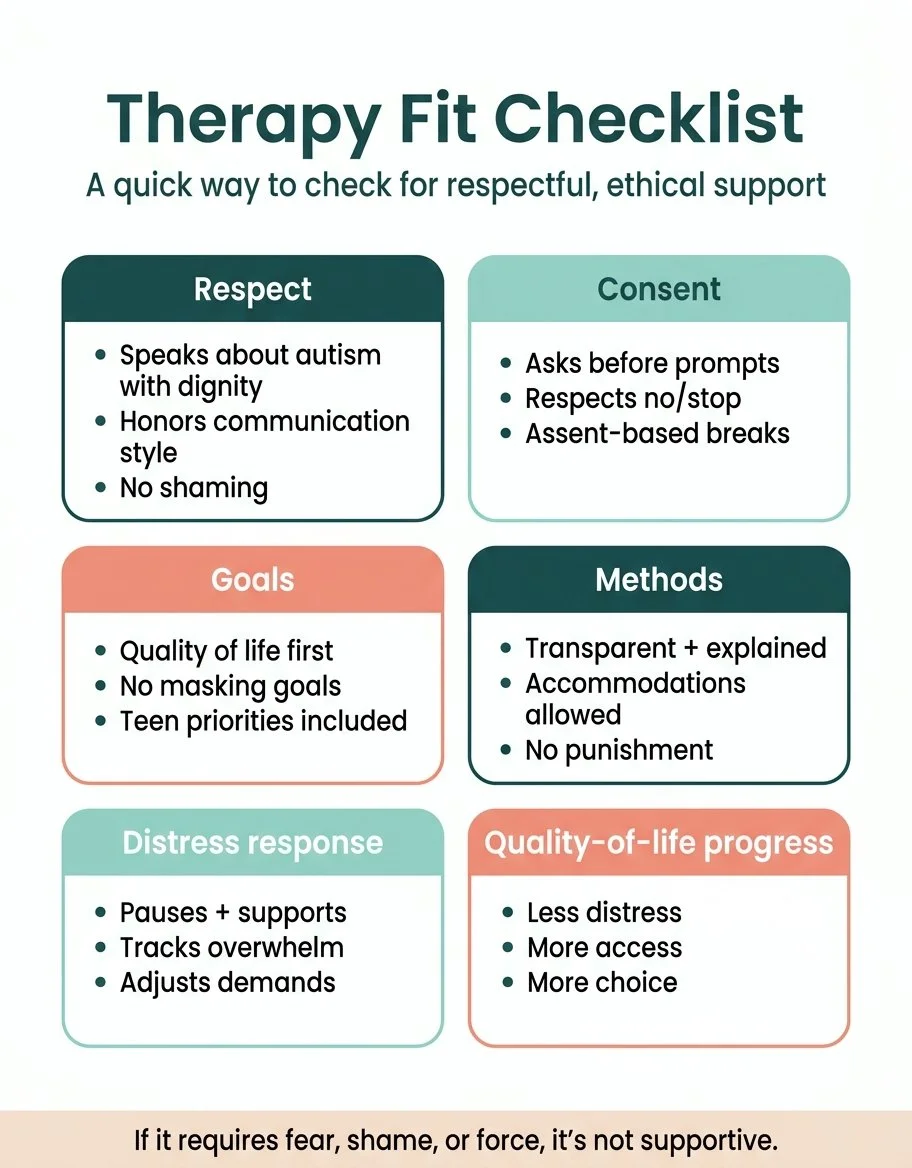
Ethical, respectful therapy should always include these things
If you remember one section from this post, let it be this one.
No matter the therapy type, ethical support should include:
Respect for the autistic person’s dignity.
Consent whenever possible, and assent-based care whenever consent is limited.
A focus on safety and well-being, not appearance.
No punishment-based methods.
Individualized goals that matter in real life.
Transparent methods that caregivers and teens can understand.
Collaboration, not power-over dynamics.
Listening to the autistic teen, including non-speaking communication.
Accommodations, not just demands.
A helpful guiding principle is:
Any approach that requires fear, shame, or force is not a supportive approach.
Criticizing every therapy (or defending only one) does not help families
Families deserve information they can use.
When conversations become “this therapy is always harmful” or “this therapy is the only answer,” a few things get lost:
Teens lose access to individualized support.
Caregivers lose the ability to think clearly under pressure.
Professionals stop collaborating.
Autistic voices get reduced to a debate point, rather than listened to.
The focus should always be the person, not the label of the therapy.
When you run into strong criticism online (or in real life)
It can be genuinely confusing when you see passionate warnings, strong opinions, or intense criticism of a specific therapy approach. Sometimes that criticism comes from lived experience and deserves careful listening. Sometimes it comes from fear, misinformation, or an “all-or-nothing” view of autism support.
Here is a steadier way to move forward:
Listen without dismissing. If someone says a therapy harmed them, that experience matters.
Avoid arguing your teen’s needs into a debate. Your teen deserves support, not a comment-section fight.
Research broadly, not narrowly. It is reasonable to explore all therapy options, including what people praise, what people criticize, and what ethical concerns have been raised.
Evaluate the provider and the methods, not just the label. Two programs with the same name can look very different in practice.
Come back to your values. Consent, dignity, autonomy, safety, communication access, and quality of life should be non-negotiables.
You do not have to choose a therapy based on the loudest opinion. You can choose based on informed research, your teen’s priorities, and what is ethical and sustainable for your family.
The MindfulMarks.care position
Here is what we want every family to hear:
We support neuroaffirming, respectful care.
We believe in individualized support plans.
We believe families deserve clear, compassionate information.
We believe autistic voices matter.
We believe safety and dignity come first.
We believe there is no one-size-fits-all therapy.
Our goal is not to tell families what therapy to choose.
Our goal is to help families make thoughtful, informed, compassionate decisions.

What parents should ask before choosing any therapy
You can save this section, screenshot it, or bring it to an intake appointment.
Fit and respect
Does my teen feel respected by this provider?
Does the provider speak about autism with dignity, not pity or fear?
Do they welcome my teen’s communication style, including AAC, processing time, and scripting?
Consent and autonomy
How do you include consent and assent in sessions?
What do you do when my teen is saying “no” with words or body language?
Are breaks, sensory tools, and accommodations allowed without punishment?
Goals and methods
Are goals individualized to my teen’s needs and priorities?
Can you explain your methods clearly without vague language?
How do you measure progress, and is quality of life part of that?
Safety and harm prevention
Do you use any punishment-based methods?
Do you target harmless stimming, eye contact, or “quiet hands”?
How do you track distress, burnout, or therapy-related harm?
Collaboration
Do you collaborate with school, OT, speech, and mental health supports when needed?
Do you welcome caregiver input without blame?
Scripts and examples (respectful, real-life language)
Script for parents who feel pressure to choose “the right” therapy
“Thank you. We are choosing supports based on our teen’s needs and what feels ethical and respectful. We are open to options, but we are not looking for a one-size-fits-all answer.”
Script for asking a provider about consent and distress
“What does consent look like in your sessions? If my teen shows signs of overwhelm, how do you respond?”
Script for asking about goals that protect autonomy
“Which goals do you typically avoid because they encourage masking or compliance over well-being?”
Script for autistic teens (self-advocacy)
“I want support that helps my life feel easier, not support that makes me pretend I’m someone else.”
Script for autistic teens (sensory and pacing)
“I can try hard things, but I need breaks and sensory tools. If I’m overwhelmed, I need support, not pressure.”
One thing to try tonight
Choose one small step that reduces pressure and increases clarity:
Write down one goal that would improve daily life (for example, easier mornings, fewer shutdowns after school, safer community skills).
Write down one “non-negotiable value” (for example, consent, no punishment, no masking goals).
Bring those two notes to your next therapy conversation.
You do not need a perfect plan to take a respectful next step.
Common myths (and a calmer, more accurate view)
Myth: “If a therapy helped one autistic person, it should help everyone.”
Reality: Autistic support needs vary widely. Fit matters.
Myth: “If a therapy harmed one person, it is always safe to ignore it completely.”
Reality: Harm should be taken seriously. It also helps to evaluate the specific provider, methods, and goals.
Myth: “More therapy is always better.”
Reality: Too much demand, even in the name of help, can increase burnout. Sometimes the most supportive change is reducing pressure and adding accommodations.
Myth: “Good therapy makes autism less visible.”
Reality: Ethical support focuses on well-being, communication, access, and autonomy.
Helpful Resources
Autistic Self Advocacy Network (ASAN) – Autistic-led advocacy and educational resources.
Autism Society – Family support, education, and local resources.
The Arc – Disability advocacy and services for teens and adults.
Understood.org – Practical learning and attention support resources for families.
988 Suicide & Crisis Lifeline (US) – Support in crisis. Call or text 988.
Supportive conclusion
If you have felt confused or overwhelmed by therapy debates, you are not alone.
Autism is different for every person. Therapy experiences vary. Both positive and negative stories exist. And no therapy fits everyone.
When we listen to different experiences without assuming they are all the same, we create space for better support, better care, and better outcomes for autistic teens.
If this topic hit home, you’re not alone. You’re welcome to visit our Substack for more gentle, practical support—and you can subscribe to receive new posts.