
When You’re Not ‘Just Tired’: The Invisible Parenting Load of Supporting an Autistic Teen (and What Helps)
A day that looks “fine” can still be too much
It was one of those days that looked “fine” from the outside.
No emergency.
No phone call from school.
No big meltdown that anyone else would understand.
Just a normal day… with a nervous system that never gets to clock out.
If you’ve ever been told you’re “just tired” when you’re actually carrying the whole support system, you’re not alone.
This post is for the parent who is doing the invisible work all day—predicting, preventing, translating, and holding routines together—while people only see the surface.
And then, we’ll talk about what helps: calm, realistic tools that lower pressure, protect connection, and make the day feel more survivable.

What this kind of exhaustion really is (it’s not a character flaw)
When you’re supporting an autistic teen (or child), fatigue isn’t always about sleep. A lot of the time, it’s about load.
Here are a few kinds of “invisible load” that often pile up fast:
Nervous system load: staying on alert because escalation can happen quickly
Decision load: making hundreds of tiny choices to keep the day steady
Sensory load management: constantly adjusting sound, light, texture, timing, and transitions
Emotional load: staying regulated so you can co-regulate
Invisible labor: being the person who remembers the routines, triggers, and what works
This is why midday can feel quiet and sharp. Not because you’re dramatic—because your brain has been running in the background all day.
Why it matters (and why it can feel lonely)
This matters because when the parenting load is invisible, it’s easy to:
blame yourself for struggling
push through past your capacity
feel guilty for needing help
feel unseen, even by people who care
And when you’re parenting solo (or functioning like a solo parent even in a two-adult home), there’s often no real “tap out.”
That doesn’t mean you’re doing anything wrong. It means you’re carrying more than one nervous system was meant to hold alone.
Common myths that make it harder (and what’s more true)
Myth 1: “You’re just tired.”
You might be tired, yes. But you might also be overloaded.
A nap doesn’t solve:
constant vigilance
constant decision-making
constant co-regulation
Myth 2: “If you were more consistent, it would be easier”
Many parents are already consistent. The issue is that consistency takes capacity.
If the routine only works when you are powering it with your body, that’s not a personal failure—it’s a support gap.
Myth 3: “If your teen can do it at school, they can do it at home”
School can require intense masking and effort.
Home is often where the nervous system finally lets go. That crash is not manipulation—it’s recovery.
What may be happening underneath (in plain language)
Here are a few common “under the surface” reasons a day can look fine but feel unbearable:
Constant micro-stress: lots of small inputs (noise, lights, demands, transitions) stacking up
Anticipatory stress: bracing for the next hard moment because you’ve lived it before
Co-regulation fatigue: using your calm voice and calm body all day, even when you’re not okay
Decision fatigue: so many tiny choices that your brain feels brittle by afternoon
Emotional whiplash: holding it together in public, then absorbing the crash at home
None of this means you’re weak. It means your body is giving you information.
What helps (calm, practical, and realistic)
You don’t need 10 new systems. You need a few supports that reduce load.
Below are options you can try and adapt. Take what fits and leave the rest.
Tool 1: Lower the number of decisions you make each day
When your brain is overloaded, fewer choices can feel like oxygen.
Try one:
Create a “default dinner” list (3–5 meals that are sensory-safe and easy)
Make a “school morning essentials bin” (same items, same place)
Use a two-option choice instead of open-ended questions (“A or B?”)
Why this helps: fewer decisions = less friction = less chance of tipping into tears by 2 PM.
Tool 2: Build one “anchor routine” that stays the same
If everything is changing, one consistent anchor helps the nervous system feel safer.
Examples:
the same after-school first 10 minutes (snack + quiet + no questions)
the same bedtime sequence (dim lights + predictable steps)
the same “reset phrase” you use when tension rises
Why this helps: predictability isn’t control—it’s nervous system safety.
Tool 3: Use connection without demand
When you’re tired, connection can accidentally turn into questioning.
Try swapping “talk to me” energy for “I’m here” energy.
Small options:
sit near your teen while they decompress (no pressure to perform)
offer a simple choice: “Quiet together or alone time?”
meet a body need first: water, snack, shower later, dim lights
Why this helps: when words are unavailable, presence still counts.
Tool 4: Protect the after-school window
Many families find after school is the highest-risk time for a crash.
Try a “low-demand landing”:
Food first
No heavy questions for 20–30 minutes
Lower sensory input (lights, noise, movement)
One transition at a time
Why this helps: it reduces the pile-on right when your teen’s nervous system is most vulnerable.
Tool 5: Make a “support menu” for you (so you don’t disappear)
If you’re the main regulator in the house, you need a plan for your body too.
A gentle “support menu” might include:
60 seconds in the bathroom with the lights off
stepping outside for three slow breaths
putting on one calming sound (fan noise, soft music)
texting one safe person one sentence: “Hard day. I’m okay but I’m maxed.”
Why this helps: micro-recovery prevents big blow-ups (and big guilt).
What may make it worse (without blaming you)
These are common patterns that can make overload spiral. If you see yourself in them, you’re not a bad parent—you’re a human under pressure.
Stacking demands: asking for multiple tasks at once when everyone is already at capacity
Asking for explanations during shutdown: “Why are you doing this?” can feel impossible to answer
Trying to solve the whole week in one conversation: big talks can feel like more demand
Correcting tone before meeting needs: sometimes the body needs safety first
A helpful reframe:
Behavior is often communication. And capacity changes day to day.
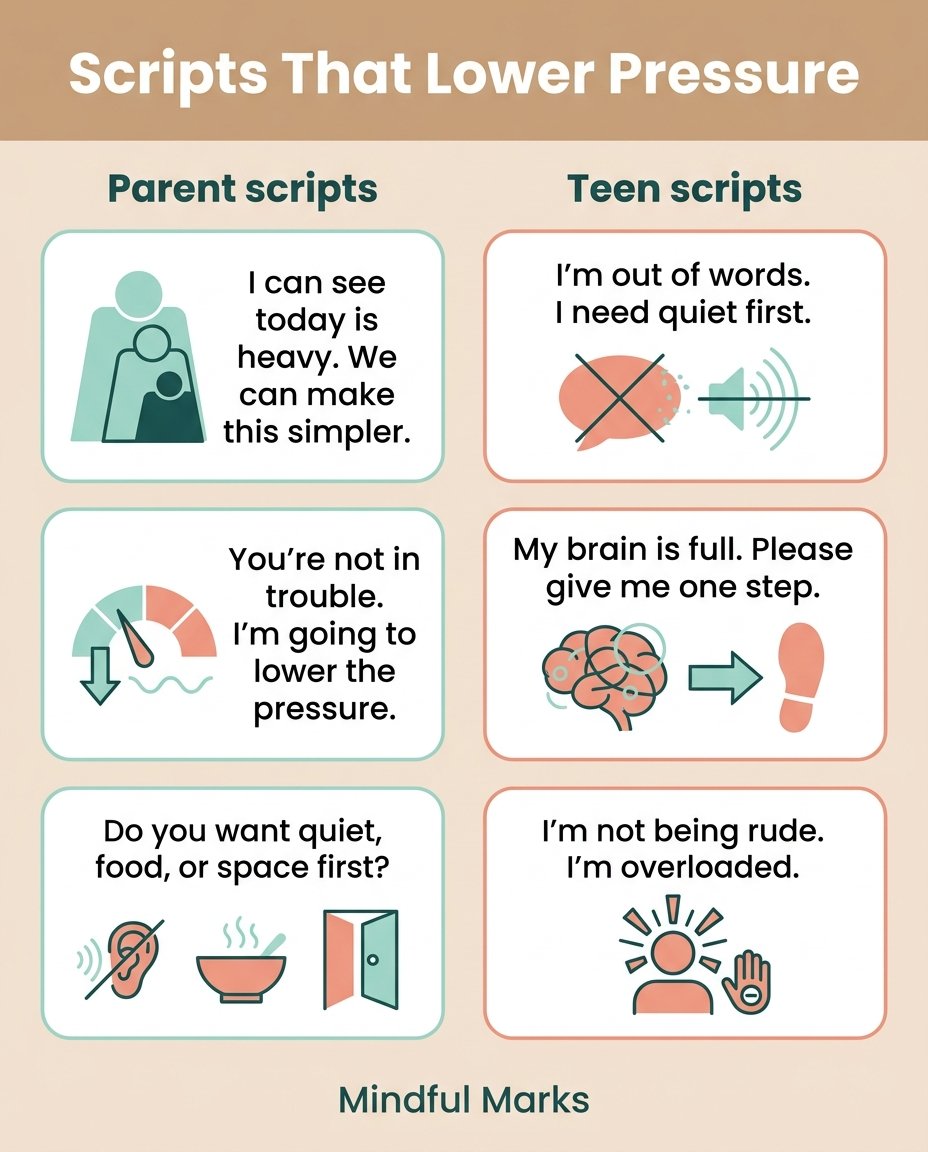
Scripts you can use (parent version + teen self-advocacy)
Parent/caregiver scripts
“I can see today is heavy. We can make this simpler.”
“You’re not in trouble. I’m going to lower the pressure.”
“You don’t have to talk right now. Do you want quiet, food, or space first?”
“I’m on your side. Let’s do one step at a time.”
Teen self-advocacy scripts (offer as options, not demands)
“I’m out of words. I need quiet first.”
“I can’t answer questions yet. I can text later.”
“My brain is full. Please give me one step.”
“I’m not being rude. I’m overloaded.”
Quick checklist: when the day looks fine but you feel brittle
Use this as a quick scan when you feel that quiet, sharp fatigue.
Body check: Have I eaten? Had water? Taken meds? Sat down once?
Demand check: Am I stacking tasks, or can this be one step?
Sensory check: Can I lower light/noise for 20 minutes?
Connection check: Am I asking for words when the body needs quiet?
Support check: Who can I text or ask for one specific thing?
One thing to try tonight (one small action)
Tonight, pick one way to lower pressure.
Try this:
Replace an open-ended question (“What’s wrong?”) with a choice:
“Do you want quiet time, snack time, or a shower later?”
Then pause.
Let “good enough” be the goal.
Helpful Resources
Autistic Self Advocacy Network (ASAN) — Autistic-led education and advocacy
Child Mind Institute — Parent-friendly mental health resources
988 Suicide & Crisis Lifeline (US) — If you or your teen need immediate support
Conclusion
If you’re parenting autistic kids solo (or carrying the load mostly alone), you are not “just tired.”
You are doing nervous system work.
You deserve shared support.
And you deserve help that lowers the load—not help that becomes one more job.
If this felt helpful, you’re welcome to join us on Substack for more calm, practical support.