
Myths About Autistic Teenagers (And What’s Actually True)
Autistic teenagers are often misunderstood—especially during adolescence, when everything gets more intense: emotions, social pressure, school demands, sensory input, and expectations of independence.
Unfortunately, myths about autism don’t fade as children grow older. In many cases, they become more harmful, shaping how teens are treated at school, at home, and in the wider world.
Let’s gently but clearly unpack the most common myths about autistic teenagers—and replace them with what’s actually true.

Teenagers smiling together outdoors in a supportive, joyful group moment, representing connection and community.
Myth 1: “Autistic teens don’t want friends.”
The truth:
Many autistic teens do want connection—but socializing can be confusing, exhausting, or overwhelming.
Autistic teens may:
Want friends but struggle with social cues
Prefer one close friend over a group
Socialize online or through shared interests
Need a long recovery time after social interaction
Lack of visible socializing does not equal lack of desire for connection.
What helps:
Interest-based friendships, structured social spaces, and removing pressure to “act normal” socially.
Myth 2: “They’re just being rude or disrespectful.”
The truth:
What looks like rudeness is often overwhelm, literal thinking, or shutdown.
Examples:
Not making eye contact ≠ is disrespect
Short answers ≠ attitude
Walking away ≠ in defiance
Flat tone ≠ , lack of care
Autistic communication styles can differ—but they are still valid.
What helps:
Assume stress before intent. Ask curious, not accusatory, questions.
Myth 3: “Autistic teens lack empathy.”
The truth:
Autistic teens often feel empathy deeply—sometimes so deeply that it becomes overwhelming.
Many experience:
Intense emotional responses
Difficulty expressing empathy in expected ways
Strong moral values and fairness
Distress over others’ pain
This is not a lack of empathy—it’s often empathy overload.
What helps:
Teach emotional vocabulary and give space to process feelings safely.
Myth 4: “They’ll grow out of autism.”
The truth:
Autism is lifelong.
Autistic teens don’t “outgrow” autism—but they do grow, learn, adapt, and thrive with the right support.
What may change:
Coping strategies
Self-awareness
Communication tools
Confidence and self-advocacy
What doesn’t change:
Neurology
Sensory processing differences
Core ways of experiencing the world
What helps:
Shift the goal from “fixing” to supporting and empowering.
Myth 5: “If they can talk, they’re fine.”
The truth:
Verbal ability does not equal emotional regulation, safety, or support needs.
Many verbal autistic teens:
Mask distress until burnout
Struggle internally despite appearing “okay.”
Experience shutdowns or meltdowns later
Have difficulty asking for help
Talking ≠ coping.
What helps:
Check in beyond words. Watch for behavior changes, fatigue, and withdrawal.
Myth 6: “Autistic teens don’t understand emotions or relationships.”
The truth:
Autistic teens experience crushes, heartbreak, jealousy, excitement, and love—often intensely.
They may need:
Explicit teaching about social and romantic boundaries
Clear explanations instead of assumptions
Safe conversations without shame
Time to process feelings
Lack of guidance—not lack of feeling—is the real issue.
What helps:
Honest, respectful conversations about emotions, relationships, and consent.
Myth 7: “Independence means doing everything alone.”
The truth:
True independence means having support systems that work—not struggling in silence.
Autistic teens may need:
Visual schedules
Step-by-step guidance
Accommodations at school or work
Support with executive functioning
Needing help does not mean failure.
It means access.
What helps:
Teach self-advocacy instead of forced independence.

Photo of: A diverse group of teenagers smiling together outdoors, representing friendship, inclusion, and support for autistic teens.
Why These Myths Matter
Believing these myths can lead to:
Missed support
Increased anxiety and burnout
Discipline instead of understanding
Teens feeling unseen or “broken”
When we replace myths with understanding, autistic teens gain:
Safety
Confidence
Emotional regulation
A stronger sense of identity

Photo of: Autistic teen smiling with sensory-friendly headphones.
One Thing to Try Tonight
Instead of correcting your teen’s behavior, try saying:
“Help me understand what felt hard today.”
Then listen—without fixing, rushing, or minimizing.
That small shift builds trust faster than any rule or lecture.
Save this for later!
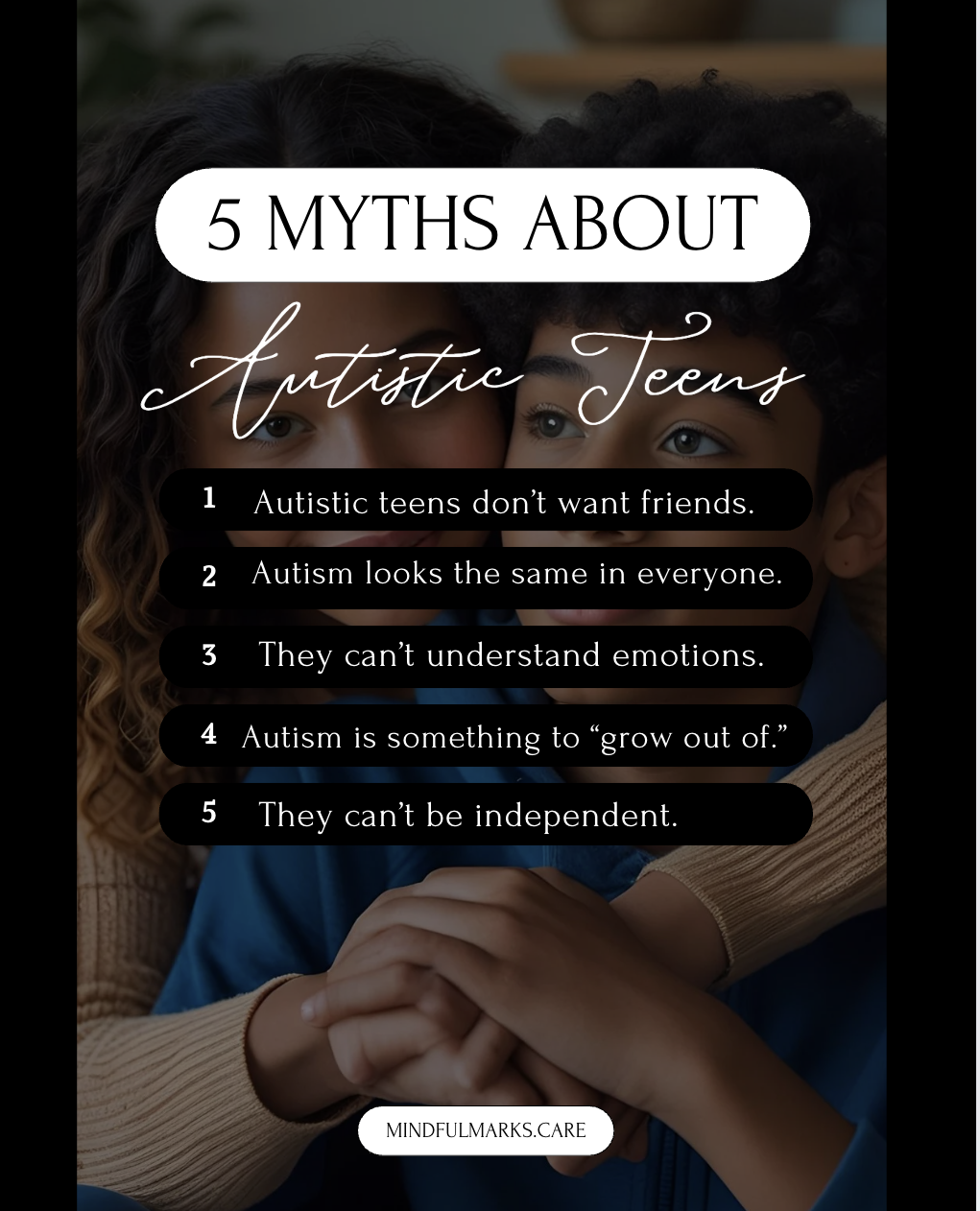
Infographic of: listing five myths about autistic teens, including friendships, emotions, and independence.
Final Thought
Autistic teenagers are not problems to solve.
They are people to understand—with strengths, struggles, creativity, depth, and potential.
When we let go of myths, we make room for connection.
If you’re building a calmer, more supportive world for your teen, you’re already doing something powerful.
You don’t have to have everything figured out today.
Supporting an autistic teen is a journey, and learning happens one step at a time. At MindfulMarks.care, we’re here to walk alongside you with practical tools, gentle guidance, and resources designed to meet your teen where they are.
👉 Next, you may find this helpful:
What is “Masking” (or Camouflaging) in Autism? — Autism Masking Explained: What It Is and Why It’s Exhausting

Infographic of: Two autistic teens smiling.