
Why My Autistic Teenager Takes Everything Literally
And How Parents Can Support Clear, Respectful Communication
If you’ve ever said something like, “Hold on a second,” and your autistic teen stood there silently waiting… or joked, “You’re killing me,” only to be met with panic or confusion—you’re not alone.
Many autistic teenagers interpret language literally, and while this can feel challenging in everyday conversations, it isn’t a flaw or defiance. It’s a difference in how their brain processes communication.
Understanding why literal thinking happens—and how to support it—can dramatically reduce frustration, misunderstandings, and emotional blowups for both you and your teen.
What Does “Taking Things Literally” Mean?
Taking things literally means interpreting words exactly as spoken, without automatically filtering for:
Idioms (“spill the beans”)
Sarcasm
Jokes
Exaggerations
Implied meaning
Tone-based hints
For autistic teens, language is often processed as information, not social guesswork. If the words don’t clearly state the meaning, confusion can follow.
Why Literal Thinking Is Common in Autistic Teens

Photo of: Autistic teen talking with her father.
1. Differences in Language Processing
Autistic brains often prioritize accuracy and clarity. Figurative language requires extra steps:
Recognizing it’s not meant literally
Inferring intent
Using social context
Decoding tone or facial cues
That’s a lot of invisible work—especially during adolescence, when the brain is already overwhelmed.
2. Social Rules Are Not Intuitive
Neurotypical communication relies heavily on unspoken rules. Autistic teens may not instinctively know when:
Someone is joking
A phrase is symbolic
Words don’t mean exactly what they say
They aren’t being difficult—they’re being precise.
3. Cognitive Load & Fatigue
When your teen is tired, stressed, overstimulated, or emotionally flooded, abstract thinking becomes even harder. Literal interpretation often increases during:
School transitions
Social pressure
Sensory overload
Anxiety or shutdowns
4. Language Has Been Used Against Them Before
Some autistic teens learn to take words literally because past experiences taught them that guessing wrong isn’t safe. Being exact can feel protective.
Common Situations Where Literal Thinking Shows Up
Parents often notice this around:
Sarcasm (“Nice job” when something went wrong)
Idioms (“Pull yourself together”)
Vague instructions (“Clean your room”)
Rhetorical questions (“Can you be quiet?”)
Exaggerations (“I’ve told you a million times”)
When expectations aren’t explicit, misunderstandings are almost guaranteed.
How Parents Can Support (Without “Fixing” Their Teen)
1. Say What You Mean—Clearly
Instead of:
“Get ready soon.”
Try:
“Please put on your shoes and grab your backpack in the next 5 minutes.”
Clarity is kindness.
2. Reduce Figurative Language at Home
You don’t have to eliminate humor—but during stressful moments, stick to literal, direct communication.
If you do use idioms or sarcasm, label it:
“That was a joke.”
“I didn’t mean that literally.”
This builds understanding without shame.
3. Teach Idioms Explicitly
(When They’re Calm)
Some teens enjoy learning what phrases mean—especially when taught like a code.
You might say:
“When people say ‘break a leg,’ they actually mean ‘good luck.’”
“Sarcasm means saying the opposite of what you mean, usually with a certain tone.”
Avoid teaching during conflict. Learning happens best in neutral moments.
4. Ask for Clarification—Model It
Normalize asking:
“Do you mean that literally or figuratively?”
“Are you joking or being serious?”
When you ask clarifying questions, you show your teen it’s okay not to guess.
5. Validate, Don’t Correct
Instead of:
“You know what I meant.”
Try:
“I can see how that sounded confusing.”
“Thanks for telling me how you understood it.”
Validation builds trust—and trust improves communication.
6. Adjust Expectations During Overwhelm
When your teen is dysregulated, processing nuance is nearly impossible. In those moments:
Use fewer words
Be direct
Avoid jokes or metaphors
Offer written instructions if helpful
Support first. Skills come later.
Reframing Literal Thinking as a Strength
Literal thinkers are often:
Honest
Detail-oriented
Trustworthy
Clear communicators
Deeply sincere
The goal isn’t to erase literal thinking—it’s to bridge the gap between different communication styles.

Photo of: Autistic teen talking with her parent
Save this as a reminder!
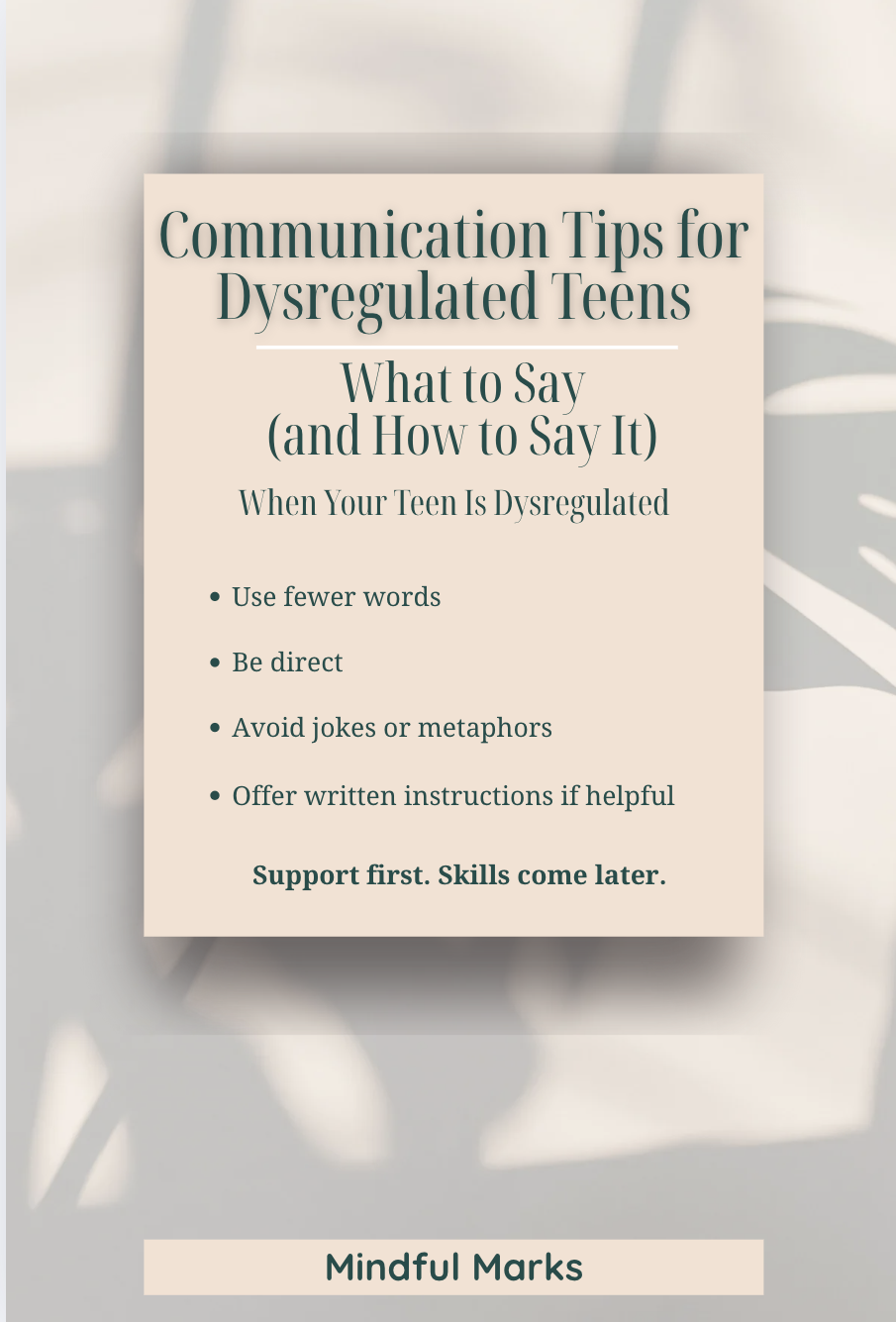
Infographic Of: Communication Tips for Dysregulated Teens
Final Thoughts for Parents
Your autistic teen isn’t being stubborn, disrespectful, or difficult.
They’re processing language in a way that values truth, clarity, and safety.
When parents meet literal thinking with patience and adaptation, conversations become calmer—and relationships grow stronger.
Clear words create calmer nervous systems.
And calmer nervous systems make room for growth.
Not sure where to go next?
If this topic sounds familiar, you may find support here:
Or

Infographic of: How to communicate with an autistic teen without escalation